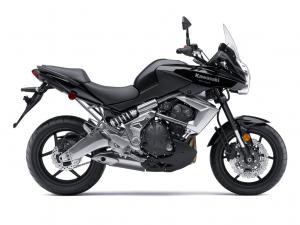
The ER-6n can be best described as a naked version of the revised-for’09 Ninja 650R, and they share a new steel-trellis frame. Kawi engineers used computer modeling to come up with a revised rigidity balance, allowing a measure of tuned flex for improved handling. The frame itself is said to be nearly as light as a comparable aluminum-alloy unit, and it boasts an upgraded finish over previous 650Rs. Both chassis also share an offset lay-down rear shock and a relatively long tubular-steel swingarm that offers extra rigidity to balance the frame’s extra flex.

You’ll also find commonality in the engine room, as both the Ninja and the ER use the compact 649cc parallel-Twin with 4 valves per cylinder actuated by double overhead cams. Both also share electronic fuel-injection systems with 38mm throttle bodies; sub-throttle valves mimic the smooth response of constant-velocity carburetors. Changes to this engine from the previous 650R consist only of a larger airbox and revised ECU mapping.
Although the ER is sure to find friends among pragmatic experienced riders, the bike has also been developed to please beginners. As such, it has such rider-friendly aids as an automatic fast-idle program to make simple cold-starts, adjustable clutch and brake levers to accommodate a variety of hand sizes, and a non-stressful upright riding position. The new frame is narrower at its midsection, allowing a slimmer seat for a shorter reach to the ground from the relatively low seat height of 30.9 inches. The ER’s transmission is also equipped with Kawi’s neutral-finder design that eases access to neutral when stopped.
Punch the starter button and the 649cc Twin blats out a tune familiar to anyone who’s heard a Ninja 650, as it has the same under-engine muffler and bullet-shaped exhaust tip. A light clutch pull eases commuter duties, and a responsive pull from the torquey engine keep you one step ahead of cage traffic. ZX-style mirrors are stalk-mounted on the handlebar to offer a clear view of the vehicles you just left behind.
Kawi’s Vibe-Away Program
While a 90-degree V-Twin like a Suzuki SV650 or Gladius has perfect primary balance that inhibits vibration, a parallel-Twin li ke the ER’s transmits some primary and secondary forces that make their way to a rider. Kawi’s Vibe Police stepped in this year with several updates to quell any bothersome trembling from its inline-Twin.
A balance shaft returns to duty in the ER/Ninja, and this year it’s augmented by the upper-rear engine mount being damped by rubber bushings. In addition, the tubular steel handlebar is rubber-mounted to inhibit vibration, and the bike’s footpegs are rubber covered. Even the bike’s handy grab rails are mounted in soothing rubber. Vibration from the previous Ninja 650R wasn’t excessive, but it’s now been reduced to inconsequential levels.
The peak output from the twin-cylinder motor – 62.9 hp at 8800 rpm – might seem a bit mild, but the impression from the saddle is of a much more capable powerplant than those numbers indicate. Torque production is a hugely important factor in how grunty a motor feels, so consider that the ER’s 43.1 ft-lbs at 7200 rpm is slightly more than a ZX-6R puts out at its peak way up at 12,000 rpm. That’s thrust you can use during every run up through the gears, and it also results in surprisingly strong roll-on performance at highway speeds. The word “underpowered” never made an entry in our notebooks.Cruising at speeds up to 80 mph is surprisingly comfortable for a naked bike, as a rider isn’t pummeled by overwhelming windblast. Credit the large headlight housing and faired instruments for deflecting wind, as well as the wide radiator shrouds which provide a wind break for legs and incorporate unobtrusive clear-lens turnsignals. Although the seat is narrow, it’s padded well enough for comfy one-hour stints.
As with any bike built on a budget, there are compromises made, and you’ll notice this on the ER mostly in the suspension and brakes.
The 6n is equipped with a conventional 41mm fork and a single rear shock that is directly mounted to the swingarm instead of using some sort of linkage. To accommodate lighter riders and to provide a cushy ride, the ER uses soft springs and damping settings. Heavy riders will want to bump up the shock’s spring preload - the only available suspension adjustment. Although aggressive riders would appreciate a stiffer front end, the fork provides decent wheel control and a smooth ride. As for the rear suspension, it works fine over most bumps, but it doesn’t have the fine control of a linkage-equipped shock. This shortcoming is most evident over repetitive highway bumps where the rear end can react harshly.
The front brakes on the previous Ninja 650 drew criticism for their lack of feel, so Kawasaki made some revisions to the componentry of this updated package also seen on the ER-6n. A new front brake master cylinder was added, and it uses a new ball-joint and a different pivot location to actuate old-tech 2-piston calipers on dual 300mm discs. They provide a newbie-friendly soft initial bite and decent power once past the initial squeeze but still don’t transmit much feedback.
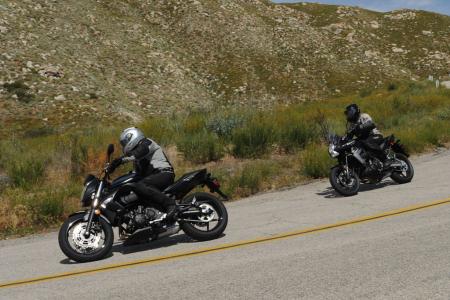
The Er-six-en impresses most when faced with a twisty, technical road – grins are sure to ensue. It proves to be very nimble despite the narrowish handlebar and conservative steering geometry (24.5-degree rake, 4.0 inches of trail). Aiding agility is a fairly short wheelbase of 55.3 inches made possible by an engine with triangular-stacked gear shafts to keep its length condensed while retaining a relatively long swingarm. Kawi claims a 442-lb weight with all fluids and a full tank (4.1 gallons) of fuel.
The ER eagerly devours a serpentine road with more speed than you might expect. The upright riding position gives a rider the feeling of dominance over the ER, allowing confidence to soar for riders of all experience levels. We challenge you not to smile! At the speeds possible on a super-curvy path like Malibu’s Latigo Canyon, the ER is able to keep pure sportbikes in sight, and I’ll bet that a newb would go quicker on the modest Kawi in this situation than he/she would on any literbike. A hint of abruptness during throttle reapplication is its only glitch.
Ground clearance at street speeds is quite generous, as a rider is able to feather the edges of the ER’s Dunlop Roadsmart tires . A sportbike-standard 120/70-17 leads the way, while a relatively narrow 160/60-17 puts the power to the ground. A short seat-to-peg distance is the byproduct of the beneficent ground clearance, constricting the legs of tall riders.
When it comes t o details, the ER-6n is well equipped. Four tie-down points are thoughtfully provided under the tailsection, there is space available under the seat for a U-lock, and a bright LED taillight aids conspicuity. Passengers are welcomed by a decent perch with generous grab rails, while a pair of cable straps under the seat provides security for two helmets.
The ER’s instrumentation is a mixed bag. On the plus side, we appreciate having a clock, fuel gauge, and dual tripmeters on the multi-function LCD screen, and the white-faced analog speedometer at the top of the pod is easy enough to read. However, the bar-style digital tachometer is too small to be seen at a glance. A gear-position indicator would be a nice touch on a newbie-friendly bike like this.
In terms of style, the ER both impresses and depresses. Its Candy Plasma Blue color (with matching shock spring) really pops, and its new frame and swingarm have an improved level of finish that adds to the bike’s perceived quality. A nifty chin spoiler frames the dual header pipes snaking curvaceously in front of the engine. On the other hand, the ER’s distinctive proboscis looks a trifle odd, making us wonder why Kawi can’t seem to make cool noses for its bikes. That said, beauty is in the eye of the beholder.
After reading this far, our affection for the ER-6n should be obvious. Riding Kawi’s newest naked around made us think that no one really needs more motorcycle than this.